

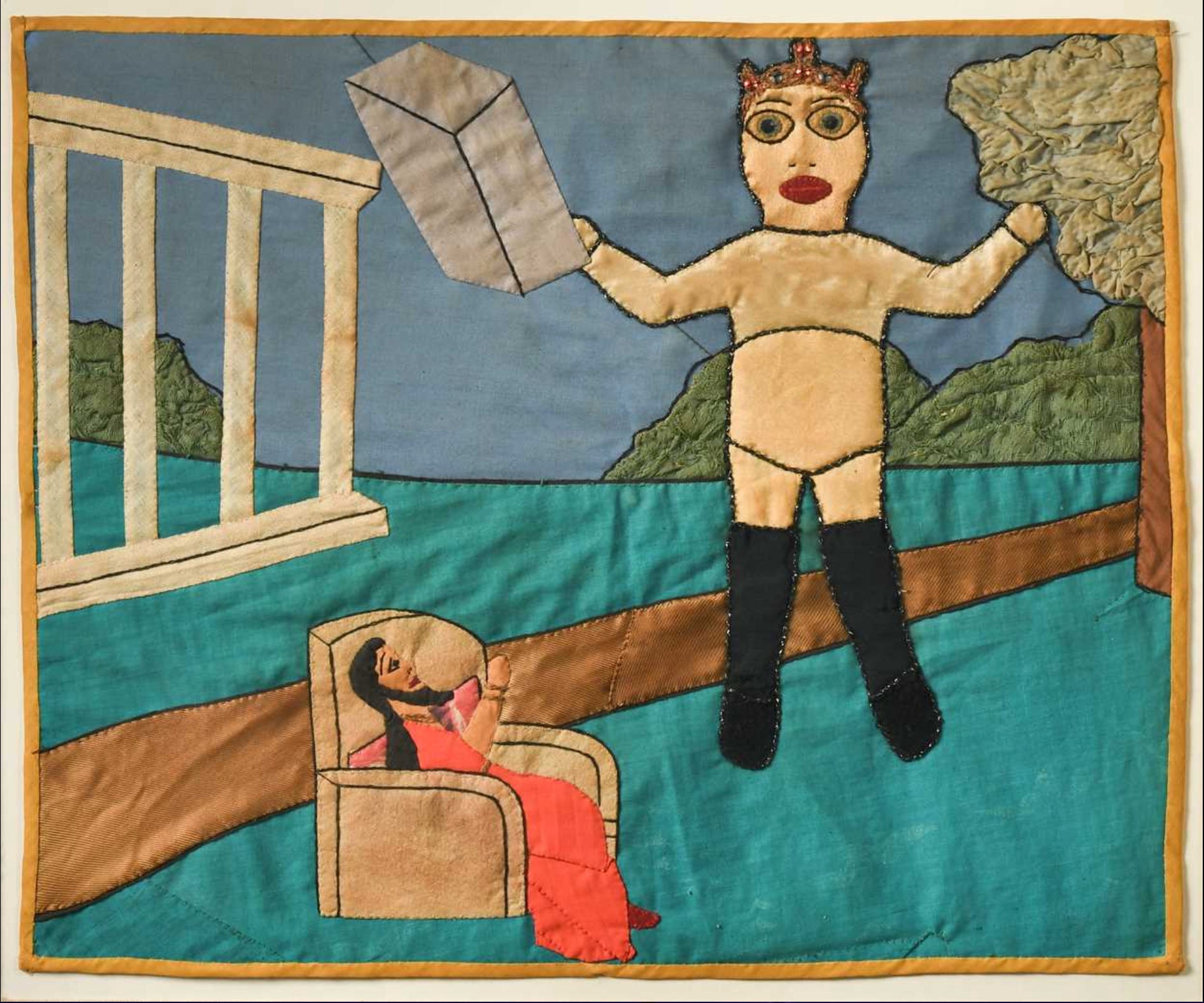
“It looks like a drag queen!” exclaimed my friend, as he looked at this picture, and smiled. And there’s a lot to smile at about this picture, even though its meaning is both more dramatic and eternal. It appears like a child has created it, mainly due to the bright colours and cartoon-like appearance. It’s a sewn appliqué artwork by Elizabeth Allen (1883-1967), the visionary outsider artist who I wrote about here, and who was the subject of a recent exhibition at Compton Verney museum and gallery.
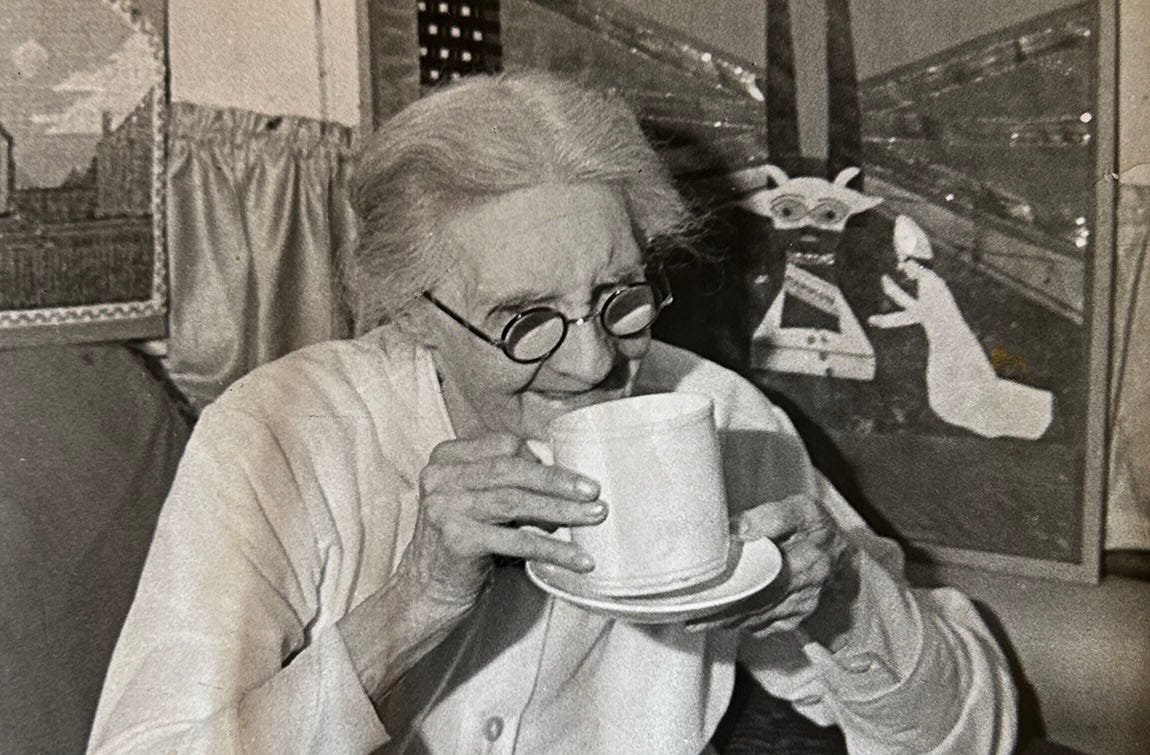
Known as ‘Queen’, due to her redoubtable spirit and sharing her first name with the then monarch, Allen created her artwork from unwanted fragments of cloth from the early 20th century until her death, aged 86. One of 17 children of immigrant German tailors, she was physically disabled and expelled from home early on in her life due to her religious beliefs. She became a recluse, an ‘outsider’, and lived her life in poverty. She never had any training in art as we understand it and she developed her own visual language to communicate stories through sewing textiles. Much of her work can be divided into one of three categories; her life, religion, and current affairs that she heard on her radio.
She rapidly rose to international fame in the last two years of her life following the chance discovery of her work by Patrick Heron and a couple of other recognised contemporary artists. An exhibition at a pioneering gallery in London propelled her to fame, with critically acclaimed follow-up exhibitions crossing Europe and the US. Only a few years later, she and her work were almost totally abandoned and forgotten by the art world that had only just lauded and heaped praise on her. Over 50 years later, her work has now been rediscovered and is being reappraised.
Now you know a little about Queen, in this article, I’m going to tell you what I think this curious picture means, and why it’s so relevant to today’s world.
The scene shows a large doll-like figure wearing a crown and wielding a cut stone in a landscape populated by trees and a colonnade of Classical pillars. A smaller bearded figure reclines in an armchair, with his arm raised. Nothing appears placed or fixed, and almost appears to float within a warped perspective. The colours are bright, bold and almost childlike, except the giant, who appears to be wearing a corset and boots.
Looking stylistically, the flat planes of colour recall paintings by Van Gogh or Gauguin, who were in turn inspired by perspectives seen on Japanese prints. The texture of the trees was created with ruched material and wool was used for the hair - both harking back to Georgian and early Victorian woolwork and silkwork pictures. All of this is fascinating as Queen did not have any exposure to art as far as we know. As for those gorgeously red lips, well, Queen also had a healthy sense of humour! The overall comic, even comical, style may be akin to folk art and even be deemed naïve, but Queen’s work is anything but naïve as we shall see.
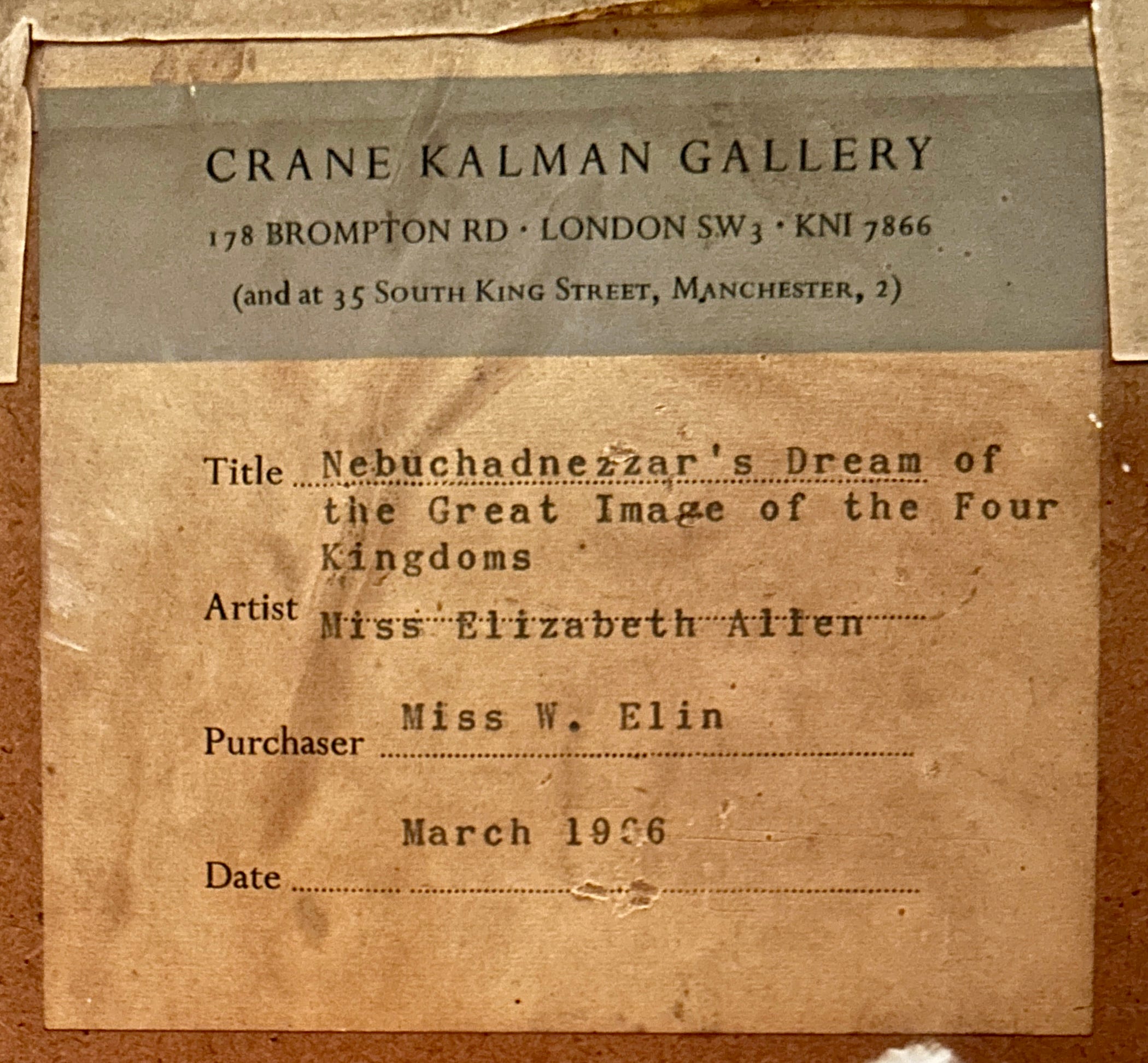
The picture is titled on a Crane Kalman gallery label on the back, ‘Nebuchadnezzar’s Dream of The Great Image of The Four Kingdoms’, together with the date it was sold in during 1966, and the buyer’s name. A grand, Biblical name for such a childlike picture! So, what’s the story?
Nebuchadnezzar II was the longest-reigning and most powerful king of the Neo-Babylonian empire, and ruled from 605 BC to 562 BC. He was one of the most powerful rulers in the world, and conquered Jerusalem and Egypt. He also rebuilt Babylon, and is said to have been responsible for the famed Hanging Gardens of Babylon. Quite the high achiever, then. The story of the dream is described in the second chapter of the Book of Daniel in the Bible’s Old Testament.
In the dream, Nebuchadnezzar had a vision of an enormous, terrifying statue of a man. The statue is composed of different materials - the feet are made from iron mixed with clay, the legs of iron, the thighs and stomach of bronze (or brass), the chest and arms of silver, and the head of gold. A huge stone, cut without human hands, strikes the giant at its feet and the giant shatters into thousands of pieces that blow away like chaff. The stone then grows into a mountain that grows and grows until it swallows the earth.
Nebuchadnezzar was deeply disturbed by the dream and summoned his advisors, scholars, and wise men to not only explain it to him, but also to do the impossible task of telling their king what he had dreamed in the first place. They are obviously unable to and, furious with them, Nebuchadnezzar sentenced them all to death for their failures. One young Jewish scholar, Daniel, prayed to God and his king’s dream was revealed to him in a vision. But what did it mean? And why has it had relevance for over two millennia, and still retains resonance and relevance today?
