

A rare early Victorian photograph of a ghost, from my collection and dating from the 1840s, nearly two centuries ago. Perfect for the night when the border between the earthly world and the spirit world is at its thinnest.
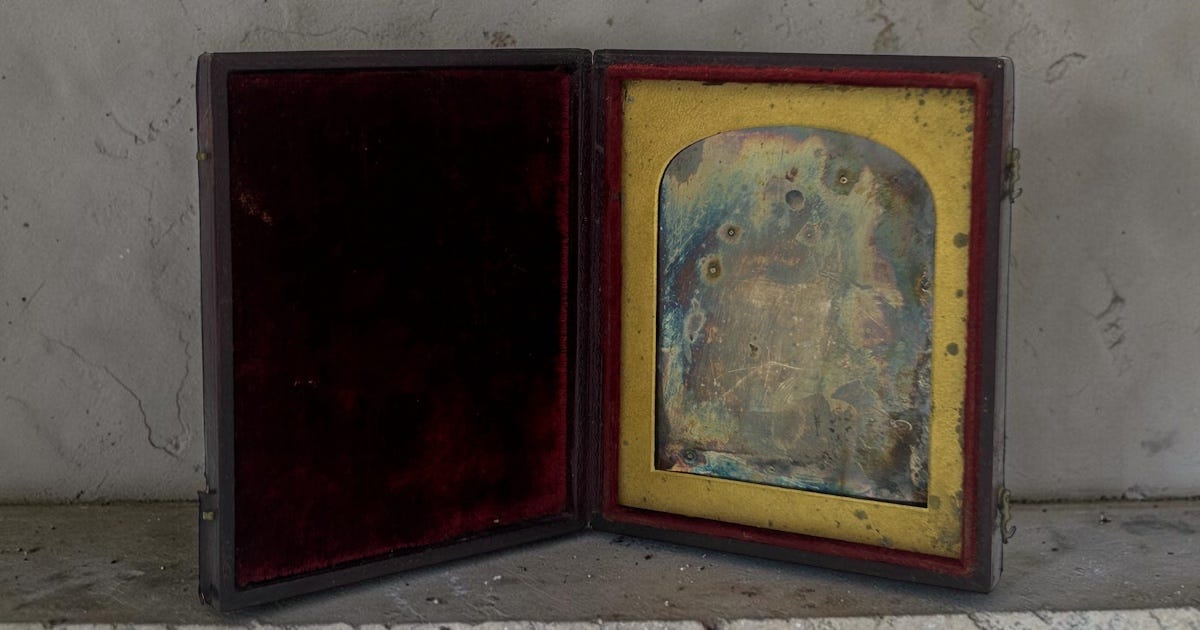
It’s a Daguerrotype, an early form of photograph developed (pun intended) and then patented by French scientist and artist Louis Daguerre in 1839. In doing so, he opened up portraiture to the many, and became a ‘father of photography’. His process was licensed to other photographers across the world, allowing more of us to capture a true likeness away from having to commission an artist to record us in paint or pencil.
The technique was complex and very ‘mad scientist’. It involved coating a thin copper plate with a fine layer of silver, and polishing it to a mirror finish. The surface was then exposed in the dark to iodine vapour, forming silver iodide, which was light-sensitive. The plate was placed into a wood and brass box camera and exposed to the light and the subject through the lens. The resulting image was then cleaned with chemicals and ‘fixed’ with mercury vapour.
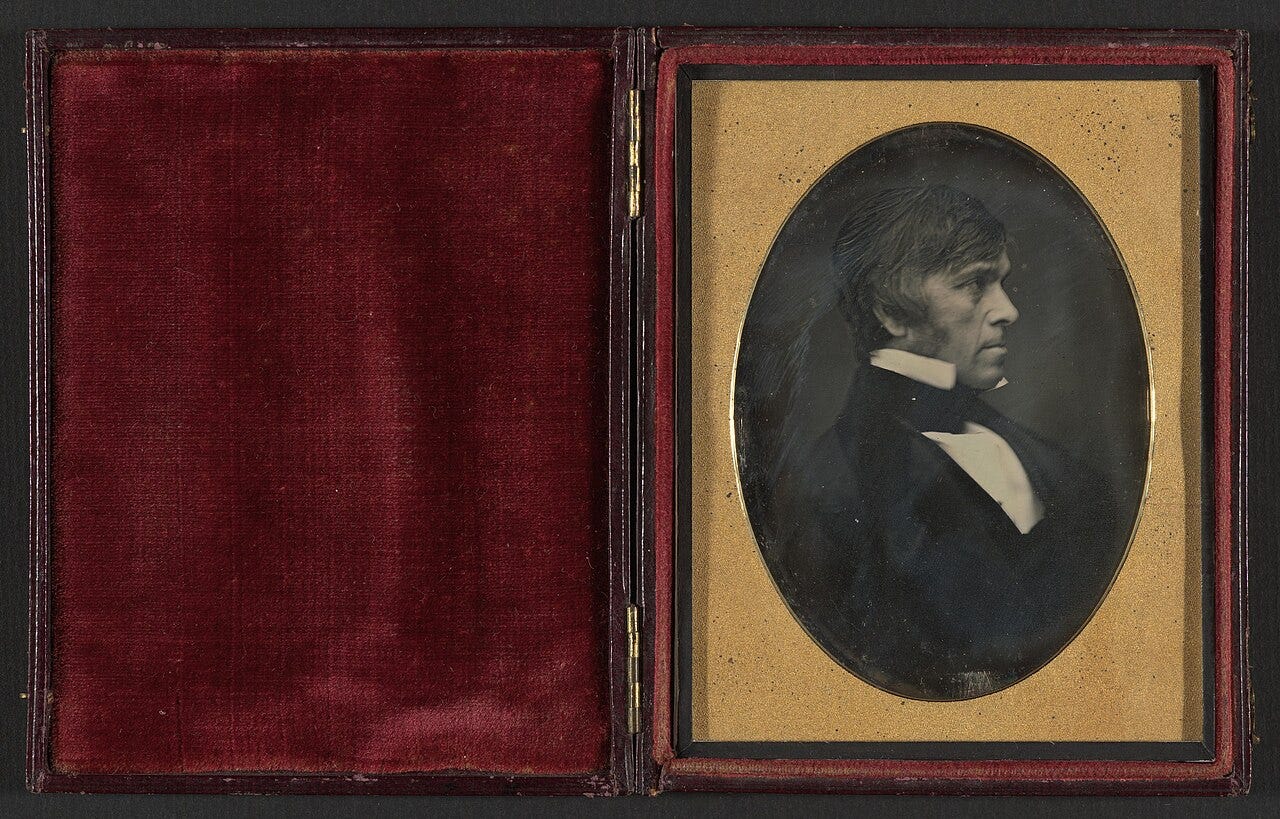
Each plate exposed is a unique image, not a print taken from a negative. The process and highly reflective surface allows it to seen as both a positive and a negative, depending on how it’s viewed. The plate was then typically placed in a burgundy leather-covered case, sealed away and protected from the atmosphere under a decorative gilt frame and a thin sheet of glass. Technology developed rapidly, within a few years improvements in chemical and lens quality allowed for even minute details and a wealth of tonality to be captured. But you had to remain still, like a corpse.
When first introduced, any movement during the 5-30 minute exposure period would cause detail-destroying blurs. During the 1840s, this period came down to a mere 10-60 seconds. Still, a long time to remain stone-still. Just try it. Maybe it helps if you’re the dead? The dead don’t move. This ghost must have been trapped, perhaps using some ancient occult ritual.
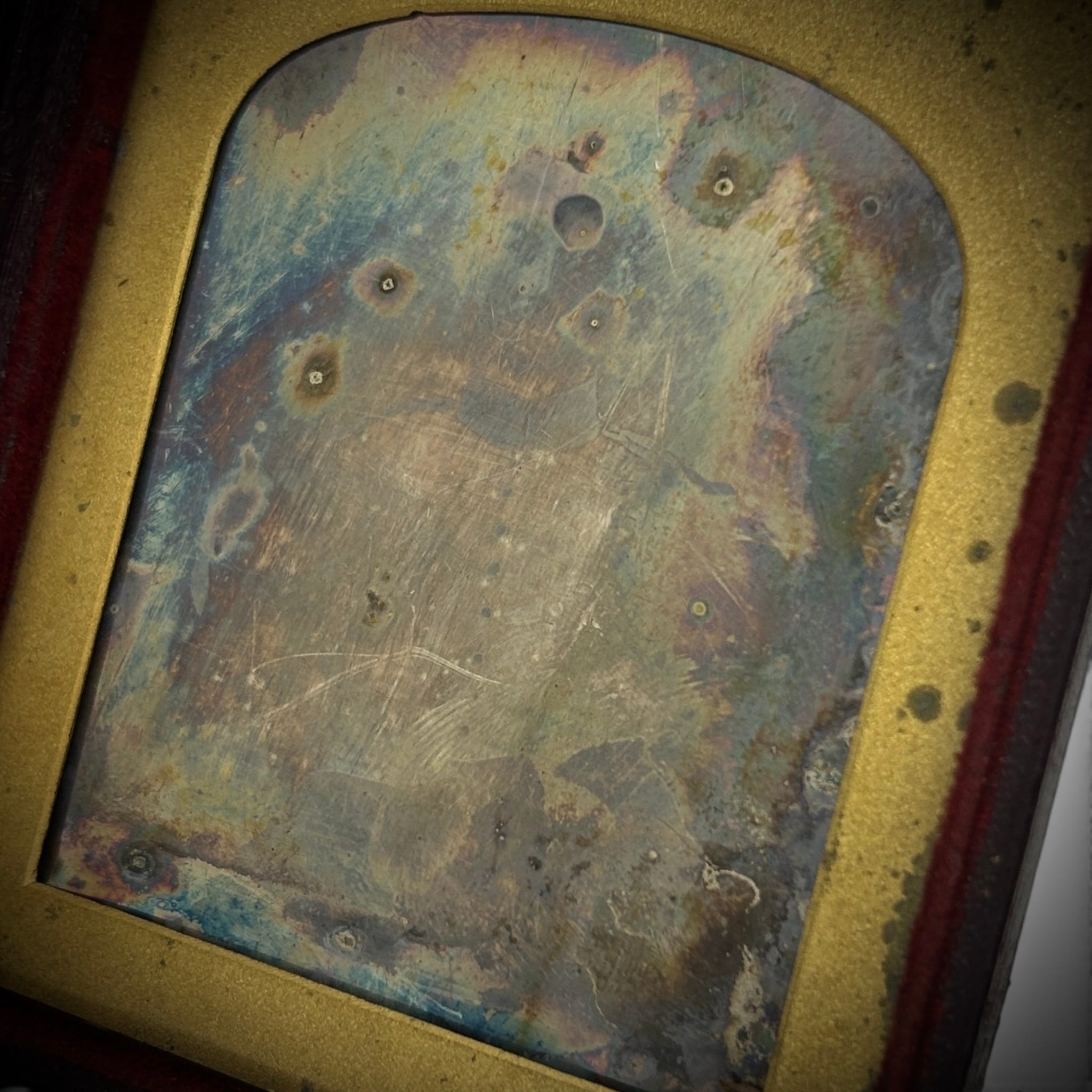
Looking closely, we see a bizarre chaos of lines and distortion. Eerie grey and iridescent blooms cover the surface, further obscuring the barely discernible subject, who appears to be a soldier with a vertical line of buttons on his tunic. Is this the static of ages? Is this the veil between us and the spirit world? The ghost emerging from amidst the chaos…
No. The glass is missing. At some point in time, the seal was broken and the atmosphere got to the silver plate which quickly became tarnished. A distraught wife or mother then took to cleaning or polishing the image to try to restore the face of her brave, lost beloved. Daguerrotypes are remarkably fragile, and any tarnishing or physical wear to the flimsy film of silver would damage the photographic image irreparably. Just like human life, it was gone forever in an instant.
So, not so much a photograph of a ghost, but a ghost of a photograph that once was. But somehow, hauntingly beautiful?
Postscript.
You may wonder why I bought it, given it’s so badly damaged and the very point of the object has long gone. There’s a healthy market for the cases amongst Daguerrotype collectors, especially the decoratively moulded ‘Union’ cases. Intensely personal, many Daguerrotypes were carried around or kept close, offering solace in times of need. Over the years and decades, the cases suffered and wore from use or storage. A Daguerrotype that fared better than this one may be perfectly preserved inside a battered case, and a professional may be able to transfer the ‘dag’ into a case in better condition. The £5 I paid for this atmospheric gewgaw is quite safe, I feel.

